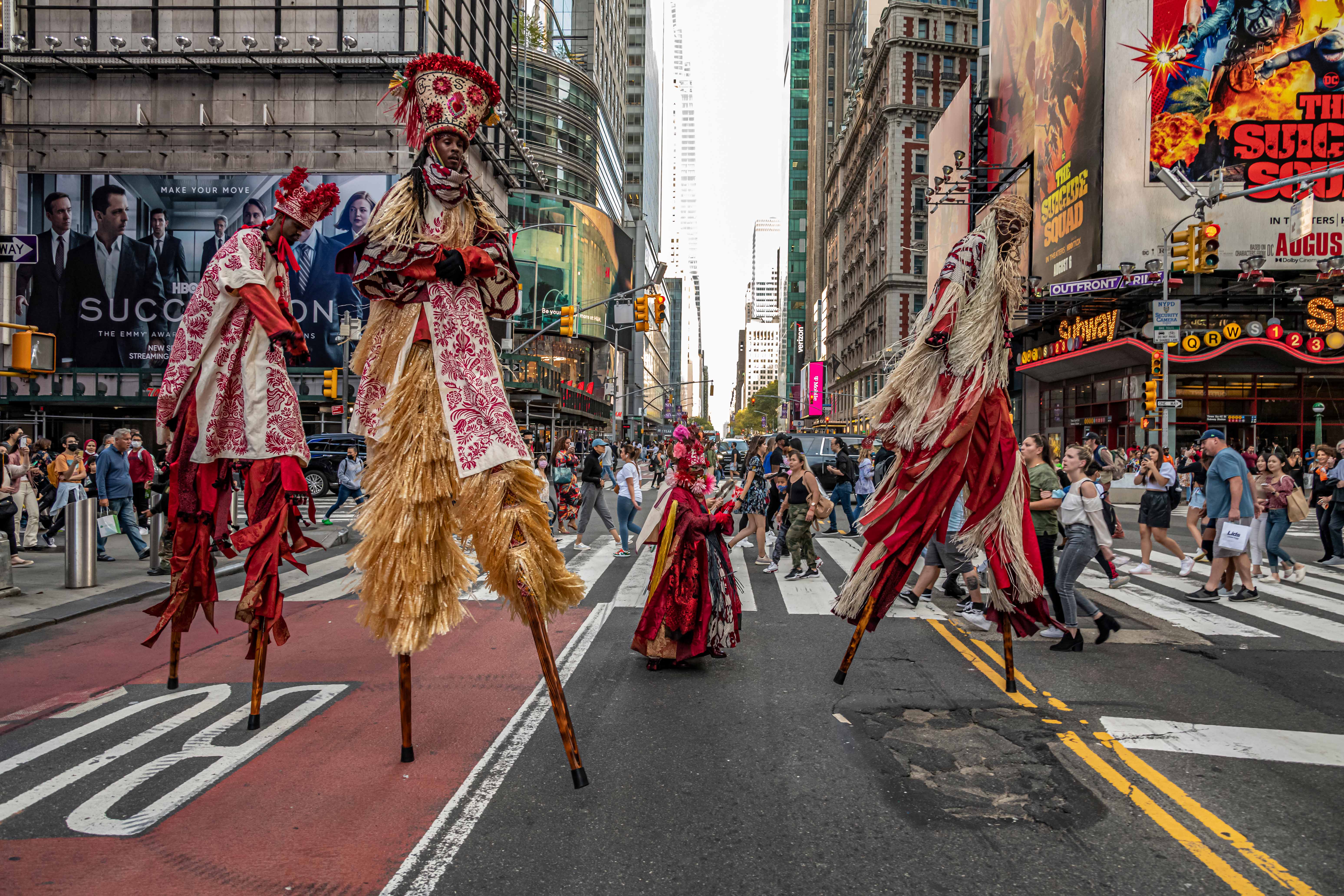
Intervention: Wayamou will be a public presentation that Laura Anderson Barbata will hold on the esplanade of the Museo Tamayo with the collaboration of the Brooklyn Jumbies, the Zancudos de Zaachila (Oaxaca) and Danza de Diablas Afrocosecha.
The first two groups are made up of traditional dancers on stilts. Other artists and musicians will accompany them to create a work that articulates elements of dance, procession, performance, music and ritual, and that encourages spectator participation. In this iteration, Mónica Gabriela Robert will play the role of the Queen, and Natalia Mendoza will play the role of the Guardian.
In the intervention, the color red will be a unifying element, whose presence will refer to the use of cochineal in Mexico, one of the oldest and most significant natural dyes. During the colonial period, cochineal was one of the most exported products from New Spain to Europe, only after gold and silver; it was associated with wealth, elegance and power, and thus acquired a notable sociopolitical value at the time. Based on this story, Anderson Barbata uses textiles and various elements in red to refer to the multiple meanings associated with that color: power, religion, life, death, passion and transformation.
Laura Anderson Barbata (Mexico City) is a transdisciplinary artist recognized for her collaborative social art projects, including Transcommunality. This joint work project with the Brooklyn Jumbies, the Zancudos de Zaachila (Oaxaca) and artisans, has been presented in numerous museums and public spaces abroad since 2001.
For example, in 2011 the artist presented Intervention: Wall Street, designed as a response to the 2008 economic crisis. In 2007, he performed Jumbie Camp, for which 24th Street in the Chelsea gallery district, in New York, closed in order to give way to a performance by 70 children in costume and members of the Brooklyn Jumbies.
In 2015, as an interdisciplinary artist in residence at the University of Wisconsin, Madison, she developed a project that involved more than 500 participants from 50 local organizations, and which culminated in the street procession STRUT!. That same year he presented Intervention: Indigo in Brooklyn, with the collaboration of Chris Walker, Brooklyn Jumbies and Jarana Beat.
Anderson Barbata currently lives and works in New York and Mexico City. She is a member of the National System of Creators and a professor in the Art, Culture and Technology Program at the Massachusetts Institute of Technology (MIT). He is an Honorary Member of the Latin American, Caribbean and Iberian Studies Program at the University of Wisconsin, Madison. Since 1992, he has worked mainly in the social sphere and has promoted projects in the Venezuelan Amazon, Trinidad and Tobago, Norway, the United States and Mexico. His work is part of important private and public collections, including the Metropolitan Museum of Art in New York, the Museum of Modern Art in Mexico City and Thyssen-Bornemisza Contemporary Art.
Brooklyn Jumbies Inc. It is an organization dedicated to fostering knowledge and appreciation of African and Afro-Caribbean cultures. Her work focuses on stilt dancing, an emblematic practice of the African and Caribbean diaspora. Founded by Ali Sylvester and Najja Codrington, the organization seeks to revitalize knowledge, respect and pride in these traditions. Brooklyn Jumbies believes that planting these values in the minds, hearts and spirits of young people and communities is fundamental to promoting cultural empowerment and self determination.
Zancudos de Zaachila. The tradition of this group stems from a promise made long ago by the inhabitants of Zaachila, Oaxaca, to their patron saint, San Pedro. Every year, the community celebrates San Pedro's birthday with a procession that goes around the town carrying his image, led by the Zancudos, dancers on stilts. Children between 12 and 14 years old can become Zancudos by promising the saint that they will dance in his honor and offer him baskets annually. In return, the saint offers them and their families health and prosperity. The leader of the Zancudos, Geovani Robles Mendoza, received the responsibility of teaching and organizing the dancers from his late grandfather, Don José Mendoza, who in turn had received the title from his father.
Danza Diablas Afrocosecha. It is an artistic and cultural collective dedicated to the interpretation of the Devil's Dance of the Costa Chica of Guerrero and Oaxaca. This dance symbolizes the collection and cultivation of afro identity, culture and resistance. The group aims to resignify it as an act of memory, identity and vindication.


.jpg)


