Tuesday – Friday: 11:00 - 17:00 h
Saturday – Sunday: 11:00 – 18:00 h
The court can be used in optimal weather conditions; if there is rain, it cannot be activated by museum staff
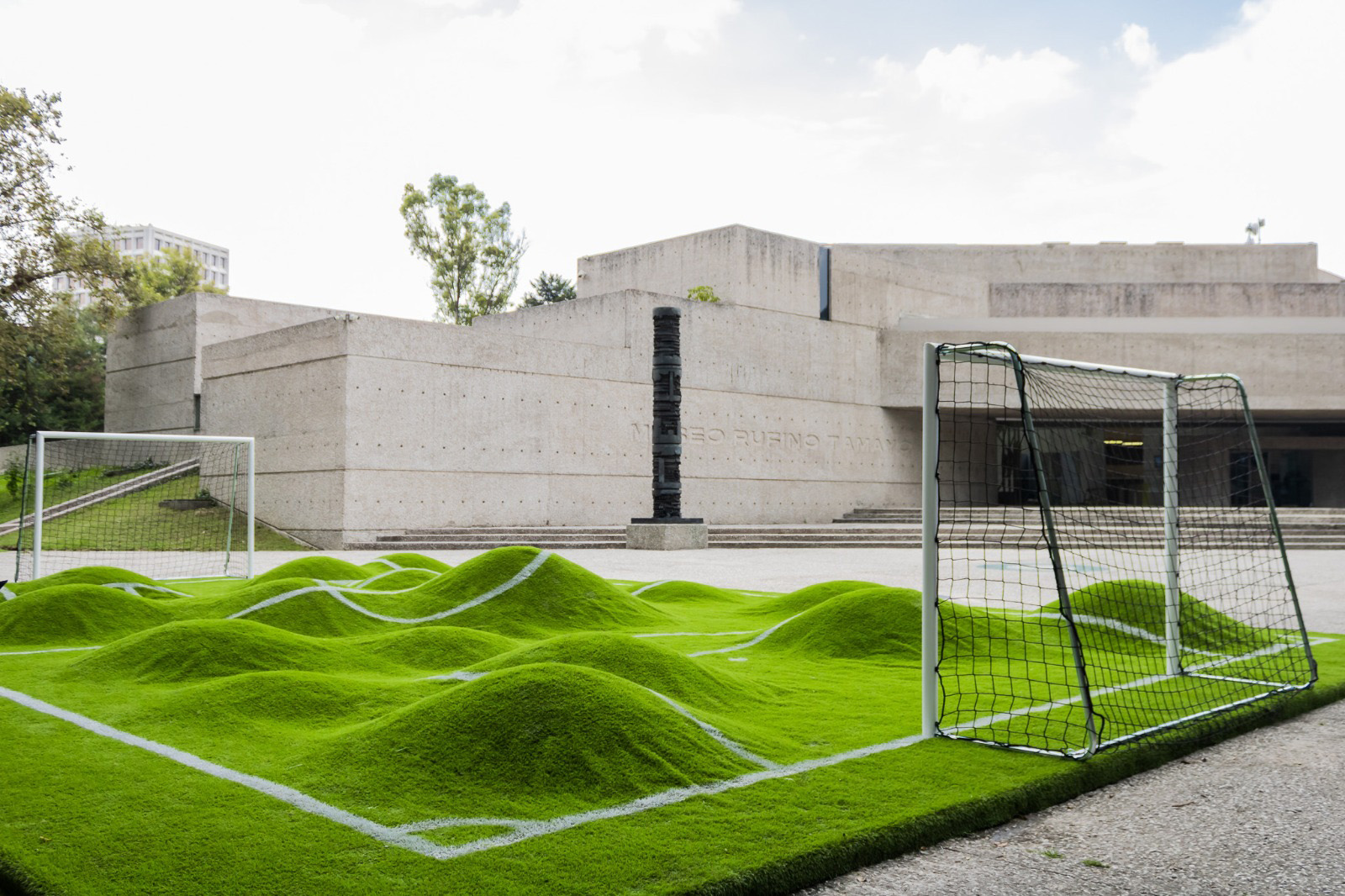
Canchas Desiguales is a piece of public art by the artist Priscilla Monge (Costa Rica, 1968), which is presented on the esplanade of the Museo Tamayo as an inter-institutional collaboration, in the context of the 2026 World Cup in Mexico City.
The piece transforms soccer as a sport and cultural symbol, into a mirror of social reality. The deformation of the terrain, with mounds and inclinations that alter the dynamics of the game, allows participants to experience bodily what it means to compete from a position of structural disadvantage.
In the artist's words: “The installation is a living space that is activated thanks to the community”. The piece does not propose a closed narrative or a dynamic of predefined use: it arouses curiosity, invites reflection and creates a space for community, encounter and coexistence that the public can freely make their own.
In Priscilla Monge's body of work, Canchas Desiguales has been established as one of his pieces with the greatest recognition and impact in public space, and has been presented in multiple institutions in Mexico and abroad. Its presentation on the esplanade of the Museo Tamayo enhances the symbolic relevance of the work: football as a universal language, public space as a stage for the collective, and art as a device to make the invisible visible.
Priscilla Monge (San José, 1968) is a multidisciplinary artist who began her career in the mid-eighties in a context in which patriarchal structures were the main basis of social behavior. She is one of the most outstanding artists in contemporary Latin American art.
In her works, she has explored the power relationships that exist in women's bodies as a catalyst for politics where femininity, in particular, operates as an effective way of disciplining the female body. His work has also focused on violence in everyday life and on the often invisible junctures between aggression, pleasure, love and tenderness.
He has participated in the Venice and Liverpool Biennials and his work has been exhibited in numerous institutions such as the Museo Nacional Centro de Arte Reina Sofía (Madrid), the MoMA PS1 (New York), the Brooklyn Museum (New York), the Museum of Latin American Art (Los Angeles, California), the Zulia Museum of Contemporary Art (Venezuela) and the Americas Society (New York), among others. His work is part of collections such as the Museum of Contemporary Art and Design in San José (Costa Rica), Tate Modern (London), Museo Nacional Centro de Arte Reina Sofía (Madrid) and the Taipei Museum of Fine Arts, among many others. In 2018, he received the Francisco Amighetti National Visual Arts Award, awarded by the State of Costa Rica.


.jpg)


